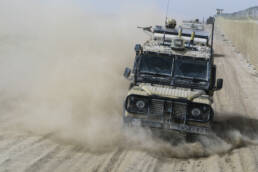

Hey guys, Andy here. The photo book Camp Bastion Unseen Images From Afghanistan by the Imperial War Museum (IWM) recently crossed my path. Published on 31st August 2026 the book features 50 previously unpublished photographs taken by IWM photographer Richard Ash who visited Afghanistan multiple times as part of an IWM team between 2012 and 2014. The aim of the visits, the first time IWM staff had visited an active conflict zone since World War 1, were to record the experiences of those involved in what as an active and ongoing conflict.
Camp Bastion was the main British Forces base in Helmand Province, Afghanistan, during the conflict between 2006- 2014 and covered 20 square miles and accommodated almost 30, 000 people at its height. It contained the ‘busiest trauma hospital in the world’, and, with approximate 600 fixed and rotary wing movements a day, was the fifth busiest UK operated airfield in the world.
Camp Bastion Unseen Images From Afghanistan clocks in at a more modest, almost pocket sized, 18cm x 18cm square format totalling 96 pages. The images cover the breadth of roles and services Camp Bastion provided, from the airport, the hospital, the water bottling, the offices, canteens, gyms, stores, and workshops, including portraits of the people involved.
As both a veteran with knowledge of Camp Bastion (and the neighbouring Camp Tombstone) and also a photographer my thoughts are, understandably, complicated. While my experiences of the camp were in 2008, while the base was still in relative infancy, I recall it being huge and residing in but a small portion. I accept four years later, when these photographs started to be taken, locations I was familiar with may have been removed or replaced as the base grew. As a photographer I also believe in the importance of working to a brief; you can not be in all places, at all times, photographing everything, let alone in a conflict zone when working with military personnel. As such, Richard Ash would, most likely, been given parameters and an aim to work to with these photographs being the result. When it comes to critiquing photography, I tend to err on the side of caution; without knowing the brief or the circumstances behind the capture of a photograph, it is easy to unfairly critical. Suffice it to say that the photography in Camp Bastion Unseen Images From Afghanistan is top notch, though I wish the book had been bigger with the images printed larger.
Given the title of the book the abundance of landscape images is to be expected which makes the 1:1 square format an unexpected, perhaps compromised, choice. In terms of layout this leads to the landscape images being given generous breathing space and their accompanying captions frequently having their own dedicated page. However the 1:1 also, consequentially, means that the close up portraits dominate the landscapes they are paired with (also the lack of standard captions for the portraits and absent post nominals is puzzling). This non sequitur is further magnified by details of the scale of operations at Camp Bastion often accompanied by a photograph depicting but a fraction of that task. Perhaps the aim is to show the human faces behind the industrial scale facilities but the juxtaposition of some of the captions and their images makes for awkward bedfellows.
Military photography presents challenges. In addition to the impossibility of obtaining model releases for everyone in each frame you also have to consider operational security; thus the post production pixelation of same faces in addition the backs of heads and motion blur of others taken ‘in camera’. Locations photographed were, presumably, not simply tidied for the sake of the camera but also, likely, sanitised to ensure they present as much while simultaneously saying as little as possible (though I doubt the restrictions placed on Richard Ash then are wholly applicable now).
It is hard not to lean into size and weight of numbers when describing Camp Bastion but there is a disconnect between what is being said and what is being shown. What was the photography brief at the time and has that remained consistent as to how the book has been compiled today? The top principle of war, as directed by British Forces, is the ‘Selection and Maintenance of the Aim: Having a single, unambiguous goal is the most important rule for success’. In this instance it does not feel this principle was adhered to.

andybarnham
I am a portrait photographer based in Cheltenham, UK. Born in Hong Kong to a Chinese mum and British dad, I had an international upbringing while I educated in the UK. I started photography as a hobby while serving as an officer in the British Army.
After my service I turned this passion into a career and became immersed in London's sartorial scene. I am now focusing my camera on portraiture and using this eye for detail which was refined over ten years. As a former Royal Artillery officer it is only fitting I shoot with a Canon camera.